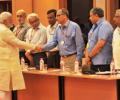
'I have seen in action six prime ministers and ten chief ministers, considered stalwarts in their days, and it is the first time, in all my experience, that a prime minister has gone into such great detail, laying down even the standards of cleanliness that should be maintained in all offices,' says B S Raghavan, former chief secretary, West Bengal.

Contrary to the bragging that marked its two-year anniversary, the government's timidity on reform is simply astounding.

If the Modi government is to keep its promise of change, it must bring in fresh faces.

We remain at the mercy of the global economic climate.

'We could crack IM modules in the country because one arrested member would spill beans on the other.' 'With ISIS, every module is different and is possibly being handled by different operators abroad.'

'If you are a slave, nobody has any problem. The conflict starts when you question and ask for equal rights.'

In an exclusive interview with rediff at his New Delhi residence this week, former Union Home Secretary G K Pillai categorically stated, "Smaller states have the advantage of effective administration as well as speedy development."

'We have been found seriously wanting in addressing our undersea warfare capability and China's emergence is a cause for concern.'

Prime Minister Narendra Modi came under scathing attack from the Grand Secular Alliance on Sunday in poll-bound Bihar with Chief Minister Nitish Kumar, Rashtriya Janata Dal chief Lalu Prasad and Congress President Sonia Gandhi accusing him of "insulting" the state and failing to deliver on any of his promises.

'Modi has entered blunderland as he does not understand the army. He has actually meddled with the army, which is much more damaging than the ignorance of Sonia Gandhi and Manmohan Singh.' 'People had an impression that the BJP was different. Now it has been made very, very, plain that it is not.' 'Look at the contrast in the behaviour of the prime minister. When they burnt buses in Gujarat for an unjust demand, the prime minister addressed them in Gujarati while the army veterans were on relay hunger strike for the 74th day on that day, but no word on this from the PM.'

Yale University has issued a statement saying that Human Resource Development Minister Smriti Irani attended a weeklong programme and received a certificate from the university last year, along with several other lawmakers from India. George Joseph/Rediff.com reports from New York
Gujarat Chief Minister Narendra Modi called for a relook at the entire ambit of Article 370, which grants special status to Jammu and Kashmir.

Nehru decided to build The Ashok in New Delhi to host a UNESCO conference. For a prime minister focussed on India building with projects like the Bhakra-Nangal Dam, IITs and factories, "the hotel spoke of the gumption of the country at that time." Manavi Kapur traces the eventful journey of the hotel, which has now completed 60 years.
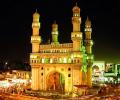
The old Hyderabadi-ness would not resurface. Nor can be recreated. For like in other cities, others too have a right to live and prosper and regardless of what states it gets, the city will not be what it was. Only people, romantic fools at that, look back. Cities don't; they look to the future, says Mahesh Vijapurkar.

Saundarya Rajesh has helped more than 8,000 women get back to work.

Is it just the glamour?
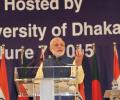
In a blunt attack on Pakistan, Prime Minister Narendra Modi on Sunday accused it of creating "nuisance" and "constantly" troubling India by promoting terrorism.

62 mass murders carried out with firearms across 30 US states. Of these, 12 were in schools, 19 at workplaces, the other 31 cases took place in shopping malls, restaurants, government buildings and military bases. The average age of the killers was 35, with the youngest only 11 years old. B S Raghavan on how the killings will continue until America confronts the urgent need for gun control.

There are indications that India may be shedding its Stockholm Syndrome vis-a-vis the Modi government, says Bharat Bhushan.

'If the RSS should be saluted for choosing such a scholarly statesman to address its highly trained cadre, one must also praise Pranab Da's sagacity for having gracefully accepting the invitation, thus disapproving any ideological apartheid,' says former BJP MP Tarun Vijay.

Over the years, pravasis have become a constituency, to be tapped, cultivated, and honoured, or at the very minimum to be listened to, says Ambassador B S Prakash.
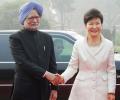
South Korean President Park Geun-hye's visit to India will enhance economic and military ties between the two countries and give the relationship a strategic dimension, says Jiye Kim.

Here's a round up of some information the nation learnt from Parliament on Tuesday.

'It is a matter of regret that the BJP and PDP refused to take the Pandits aboard in this government.' 'The present government is following a policy of soft secessionism.'

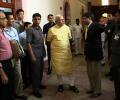
Who are the men the prime minister relies on to execute his impressive agenda?

Amit Shah is the man of the moment. The architect of the BJP's stunning transformation in the Hindi heartland during the Lok Sabha elections is all set to emerge as the CEO of Modi's political dreams and the Rashtriya Swayamsevak Sangh's cultural passion, says Sheela Bhatt.

Opposition on Monday picked holes in various government decisions like demonetisation and surgical strikes as well as allocation of funds for MNREGA, agriculture sector and Scheduled Castes, saying it has failed on all fronts despite which it is trying to "fool" the people.
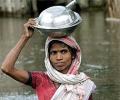
The local labour force is streaming out of the region, creating a vacuum that makes it easier for the Bangladeshis to fill in, says R N Ravi

Prime Minister Narendra Modi, who recently completed one year in office, has, in an exclusive interview with Smita Prakash, editor, ANI, said the opposition alleging that his government is a "suit boot ki sarkar" is definitely better and more acceptable than being labelled a "suitcase" (ki sarkar), and satirically added, that after ruling for sixty years, the Congress has suddenly remembered the poor.

'Why should the people of Odisha divert water from the Mahanadhi when 13 out of 32 districts are chronically drought prone?' 'Water is a state subject. Can you really nationalise rivers for which you need drastic amendments in the Constitution?'

What is the road ahead for Rahul Gandhi? Shehzad Poonawalla offers a blueprint.

Indian economy about to take-off
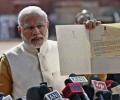
he has to demonstrate the ability of his government to take a quantum leap, almost tantamount to setting the Ganga on fire, in the next six months, if not in 100 days, if the people were to take seriously the cascade of commitments spewing out of the President's address to both Houses of Parliament on June 9, says B S Raghavan. B S Raghavan suggests five practical propositions through which the Modi government can bring in paradigm changes.
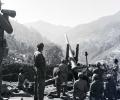
Fifty years ago, India and Pakistan fought a short but bloody war. The author finds out how Sainik Samachar, the defence ministry's journal, reported it.

President Pranab Mukherjee on Monday addressed the first joint sitting of Parliament as mandatorily required under the Constitution after the general elections. The address is the political, economic and foreign policy road map of the Narendra Modi government and covers virtually all crucial areas.
 © 2026 Rediff.com - Advertise with us - Disclaimer - Privacy Policy - Sitemap - Feedback - About us - Terms of use - Grievances